We build on concepts and examples explained previously, but try to keep this section self-contained from a technical point of view.
We specialise the setting from Coalgebraic Logic: Introduction as follows:
a functor
a functor
given by
given by
We have seen previously that modal logics for -coalgebras can be described by giving and .
Conversely, every sifted colimit preserving functor on a variety has a presentation and hence gives rise to a modal logic. Before we see how this works let us state some results needed later.
Proposition: Let be a sifted colimit preserving functor on . There is a functor that agrees with on all non-trivial algebras and preserves filtered colimits. Moreover .
Lemma: Let be a functor on and a sifted colimit preserving functor on and for all finitely generated free Boolean algebras . Then for all finite non-trivial algebras .
Proof: Every finite non-trivial Boolean algebra is a retract of a finitely generated free one.
The logic of 
As promised, we are going to show that every sifted colimit preserving functor on a variety has a presentation and hence gives rise to a modal logic.
Every sifted colimit preserving functor on a variety is a quotient
where . Since is a left adjoint, the morphism is the adjoint transpose of a morphism
which determines (and is determinedy by) the following modal logic.
The -ary modal operators are the elements of .
maps to where is the adjoint transpose of .
The equations in variables are the kernel of .
In particular the are modal formulas
where and .
The set of operations and the set of equations constitute the presentation of .
Example: The variety of Boolean algebras with operator (BAO) is presented by the operations and equations of Boolean algebra plus a unary operation and two equations specifying that preserves finite meets.
Moss’s coalgebraic logic
The first proposal for a logic of coalgebras parametric in the coalgebra functor was Moss’s coalgebraic logic. It can be obtained by defining via a presentation
where . Originally, Moss’s logic did not have equations, which corresponds to taking the to be identities. This use of the functor itself as a syntax constructor for a logic yields a very interesting presentation. This presentation is equivalent in expressiveness (in case preserves weak pullbacks) to the ones we know from classical modal logic, but is quite different in terms of the opportunities it offers as a logical tool. For more see the section on Moss’s Coalgebraic Logic.
The logic of all predicate liftings
Pattinson introduced predicate liftings to give a parametric treatment of coalgebraic logic that includes classical modal logic as an example. The logic of all predicate liftings can be defined in our setting in a natural way.
Remark: Note that Moss’s logic is defined by applying directly to syntax, whereas here we want to use the duality given by and to keep on the semantic side of the duality. In fact, we might have been tempted to simply define and while this is still the guiding idea, this direct approach is only suitable if we start from a dual equivalence of base categories such as the one given by complete atomic Boolean algebras and Set or the one given by Boolean algebras and Stone spaces. Moreover, defining will not, in general, result in a sifted colimit preserving functor and, thus, not, in general, allow us to find a finitary presentation of by operations and equations.
Syntax
We define on finitely generated free algebras:
We extend to all algebras via sifted colimits (hence preserves sifted colimits by definition).
Moreover, is the set of all -ary predicate liftings:
Since preserves sifted colimits it has a presentation by operations and equations and this presentation presents by all predicates liftings as
where .
Semantics
The semantics is given as follows.
, we do not need to go via the finitely generated free algebras and can define for finite directly as the isomorphism
which, in terms of the presentation of by modal operators, corresponds to
where
on the left is understood as syntax, that is, and and
on the right is evaluated by taking the predicate lifting as a function , that is, as a function .
From Funtors to Predicate Liftings and Back
Every sifted colimit preserving functor with a semantics can be represented by predicate liftings. Conversely, each set of predicate liftings presents a functor together with a semantics. We summarize this corrspondence.
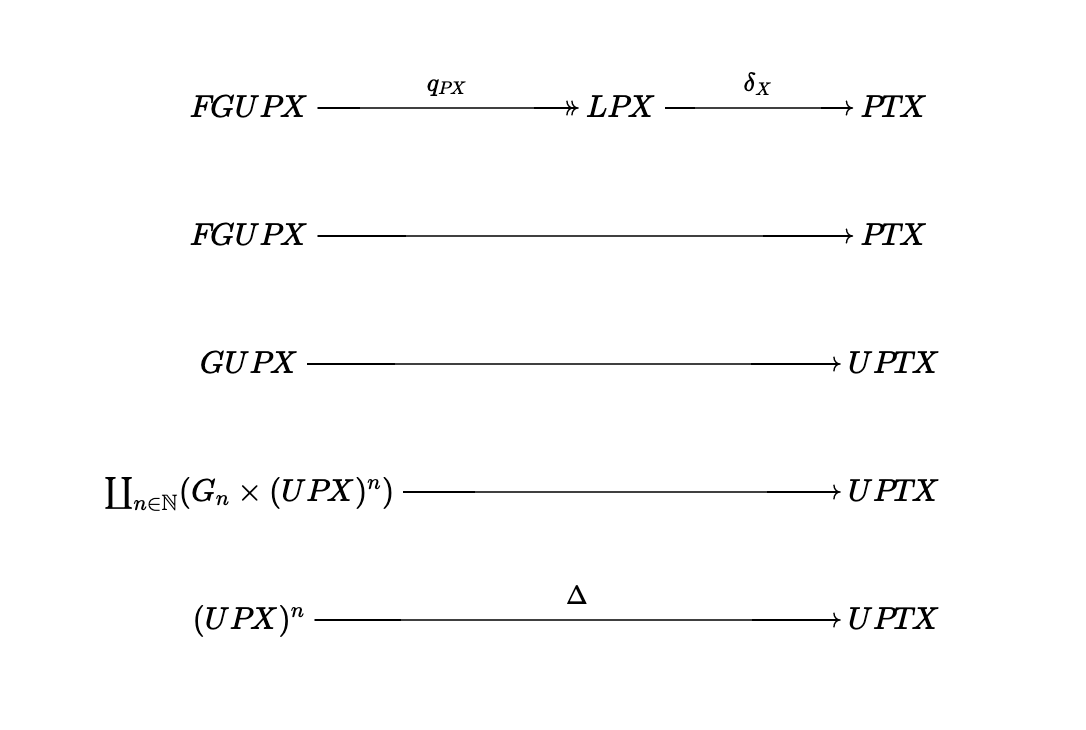
Starting with a functor , its presentation and its semantics , we obtain its presentation by predicate liftings in the last line, where ranges over all elements of . Conversely, any collection of predicate liftings defines a functor obtained from “climbing the ladder up” and quotienting the corresponding .
References
Kurz-Rosicky: Strongly Complete Logics for Coalgebras, 2012.
Diagrams: