(draft)
Definition
A -ary predicate lifting for a functor is a natural transformation
It follows from the Yoneda lemma that such natural transformations are in bijection with functions
In one direction, we apply to the idenity on to obtain .
In the other direction, each induces a modal operator as follows.
Given a predicate lifting and a collection of predicates , we obtain defined as
Precomposing with a coalgebra the semantics of a modal formula
is then given by
A good way to understand what is going on here is to explicitely calculate all unary predicate liftings of the powerset functor.
But before doing this let us clarify terminology.
First, to simplify notation, we will only consider unary predicate liftings in the following.
Terminology: We tend to say predicate lifting for the function
and modal operator (or sometimes predicate transformer) for the function that maps a predicate to the predicate
Question: Would it be better to reverse the terminology? Or perhaps as follows:
predicate lifting
predicate transformer
modal operator:
Anyway: Since there is a bijection between predicate liftings and modal operators, we may blur the distinction on occasion.
Example: Powerset
Let be the powerset functor.
We see right away that there are 16 modal operators
because that is the cardinality of the set of functions of type .
We are interested in explicitely describing all modal operators taking predicates to
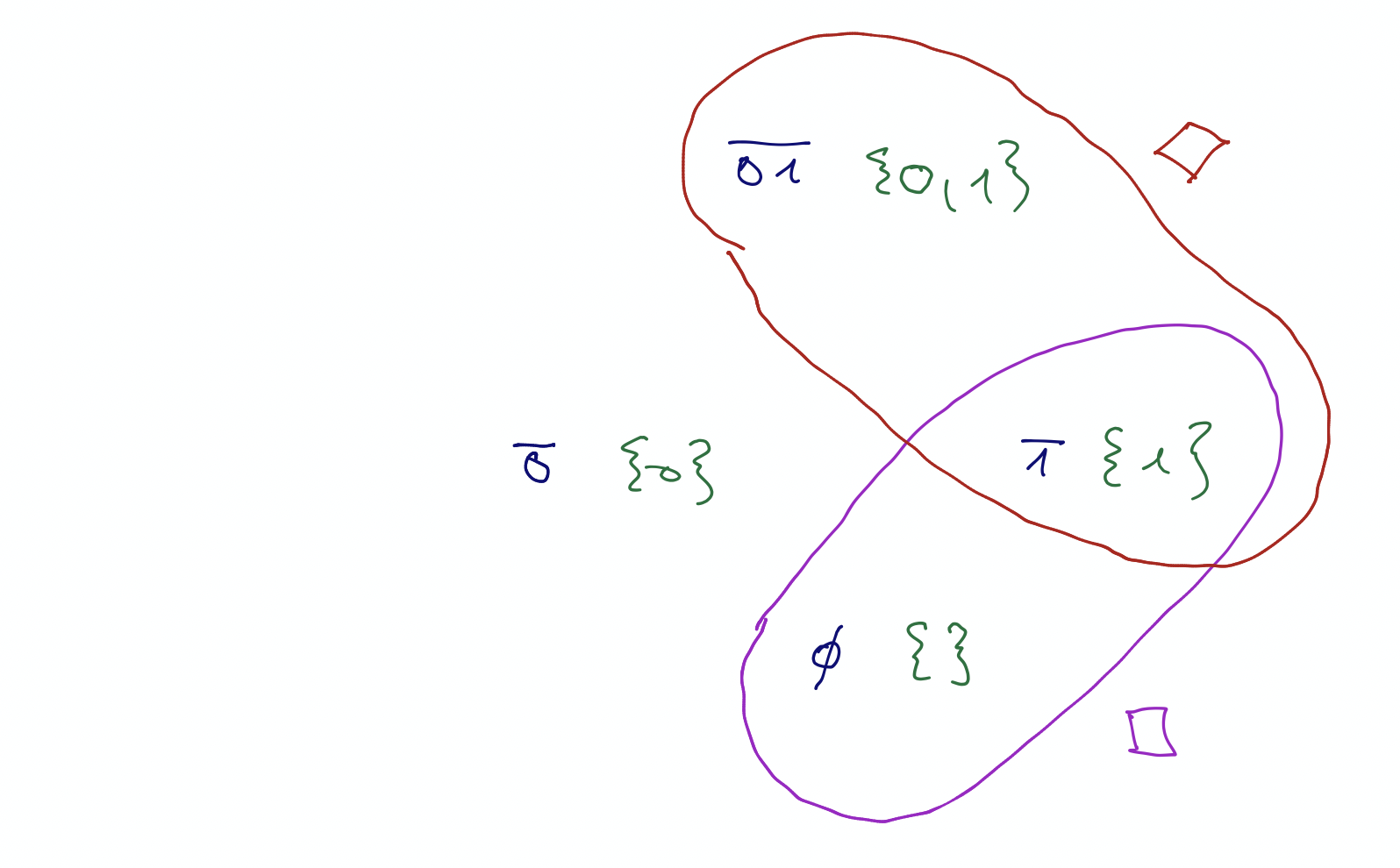
We need to know that takes direct image. This tells us how to interpret the 4 possible results of applying to a set of successors. Writing , if is [1]
then some successors are outside of and some are inside of .
then all and some successors are out.
then all and some successors are in.
then there are no successors.
For the purpose of further calculations I propose the following abbreviations:
for the elements of .
Exercise: (Assumes familiarity with the classical definition of the modal operators and ). Show that defines and that defines . [2]
Answer. [3]
Observation: The modal operator coincides with and the modal operator coincides with .
Modal logic is expressive up to bisimilarity and this means here that all predicate liftings (and also all ) are generated by those for and . Let us try to support this with some examples:
Exercise: Using as well as propositional connectives, express the predicate liftings defined by where ranges over . Also verify that holds for the corresponding predicate liftings.
Our next concern is to better understand the lattice (Boolean algebra) of all unary modal operators of the powerset functor .
We already noted that there are 16 unary modal operators and we exhibited some salient examples.
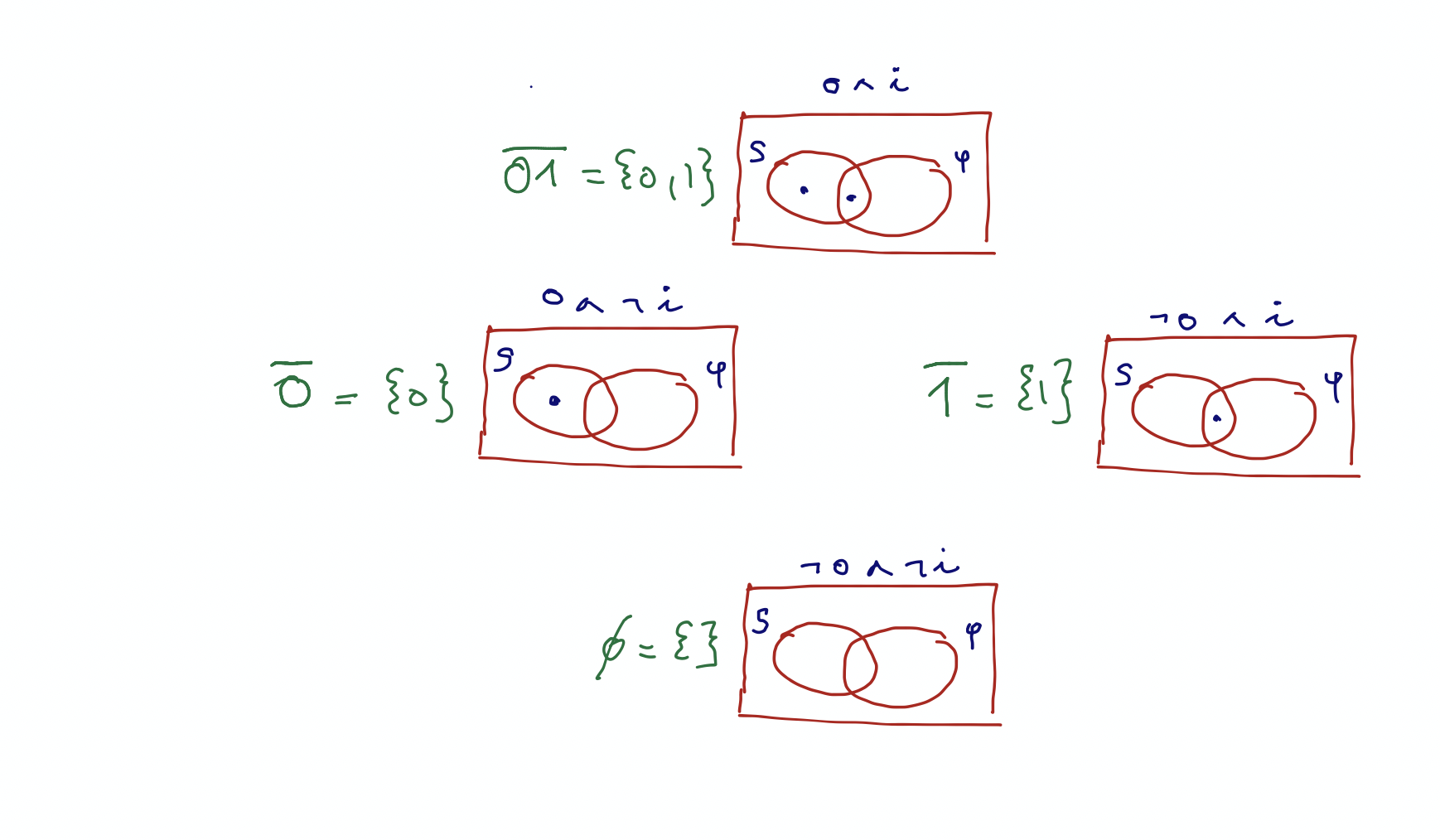
From general facts about Boolean algebras we can deduce the following. The Boolean algebra of modal operators is isomorphic to the free Boolean algebra on two generators, which I call and . [4] These generators combine to the atoms of the Boolean algebra as
Every element of the Boolean algebra of modal operators is a join of these atoms.
Exercise: Define an isomorphism between predicate liftings and the free Boolean algebra generated by which maps to and to .
Answer. [5]
Remark: The isomorphism in the previous exercise has been chosen in such a way that the generator is interpreted as “some successors are outside of ” and as “some successors are inside”.
This choice of interpretation is suggested by how the functor acts on (as direct image). In particular, symbolizes the observation that the direct image under of the set of successors contains 0 and that the direct image contains 1.
From the point of view of Boolean generators there is no reason to prefer over . But from a logician’s point of view , which is , has the advantage of being a monotone operator. We will study this in more detail in the follow-up note on monotone predicate liftings.
Remark: Items 1. and 2. could be the starting point for a rational reconstruction of why classical modal logic is usually presented in terms of and . One would begin with the question of a logic that is invariant under bisimilarity, answer that such a logic is given by the logic of all predicate liftings and then proceed to the insight that and generate all predicate liftings in a canonical way.
Summary: We introduced some notation for the set
and then represented the unary modal operators as subsets of . For example,
(“nothing out”)
(“at least one in”)
As a corollary we identified and as the generators of the free Boolean algebra of all unary predicate liftings.
Puzzle: If we equip with the inclusion order, then is not a monotone function (when 2 is ordered as ). On the other hand, we do know that is a monotone modal operator in the sense that [6]
This puzzle will be resolved in a follow-up note on monotone predicate liftings.
Example: Probability Distributions
Let be the functor that maps a set to the set of finitely supported probability distributions.
The unary modalities are given by sets of distributions on 2
A modal operators takes a predicate to
The atoms of the Boolean algebra are the sets where . If is , then
This reminds me of the square of opposition in Aristotelian logic. corresponds to “belongs to all successors”, to “belongs to no successors”, to “belongs to some but not all”. As far as I understand (not my area of expertise) Aristotle’s logic does not admit .
Here and in the following all elements not explicitly mentioned are sent to 0. For example, writing implies .
For example, in the case of , one has to verify that with defined as the function maps to 1 iff .
Intuitively, means “some successor outside of ” and means “some successor inside ”. It is a lucky coincidence that the symbol reminds us of both out and 0 and of both in and 1.
Recall that means “no successor”, means “some and all successor outside of ”, means “some and all successors in ” and means “some out and some in”. Accordingly, we map the elements to conjunctions of generators as follows. , , , .
It also makes sense to replace by if we think of predicates as propositional functions to .