Skip to article frontmatterSkip to article content
Site not loading correctly?

This may be due to an incorrect BASE_URL configuration. See the MyST Documentation for reference.

Monotone Predicate Liftings

(draft)

In a previous note, we defined predicate liftings and showed that the unary predicate liftings of the powerset functor are isomorphic to the free Boolean algebra generated by \Box and \Diamond.

Here, we first single out all of those 16 modal operators that are monotone.

Then we are going to test our insights by studying the predicate liftings of two posets functors, namely the upset functor U\mathcal U and the downset functor D\mathcal D.

Set Functors

We have studied modal operators as predicate liftings

P22\mathcal P 2\to 2

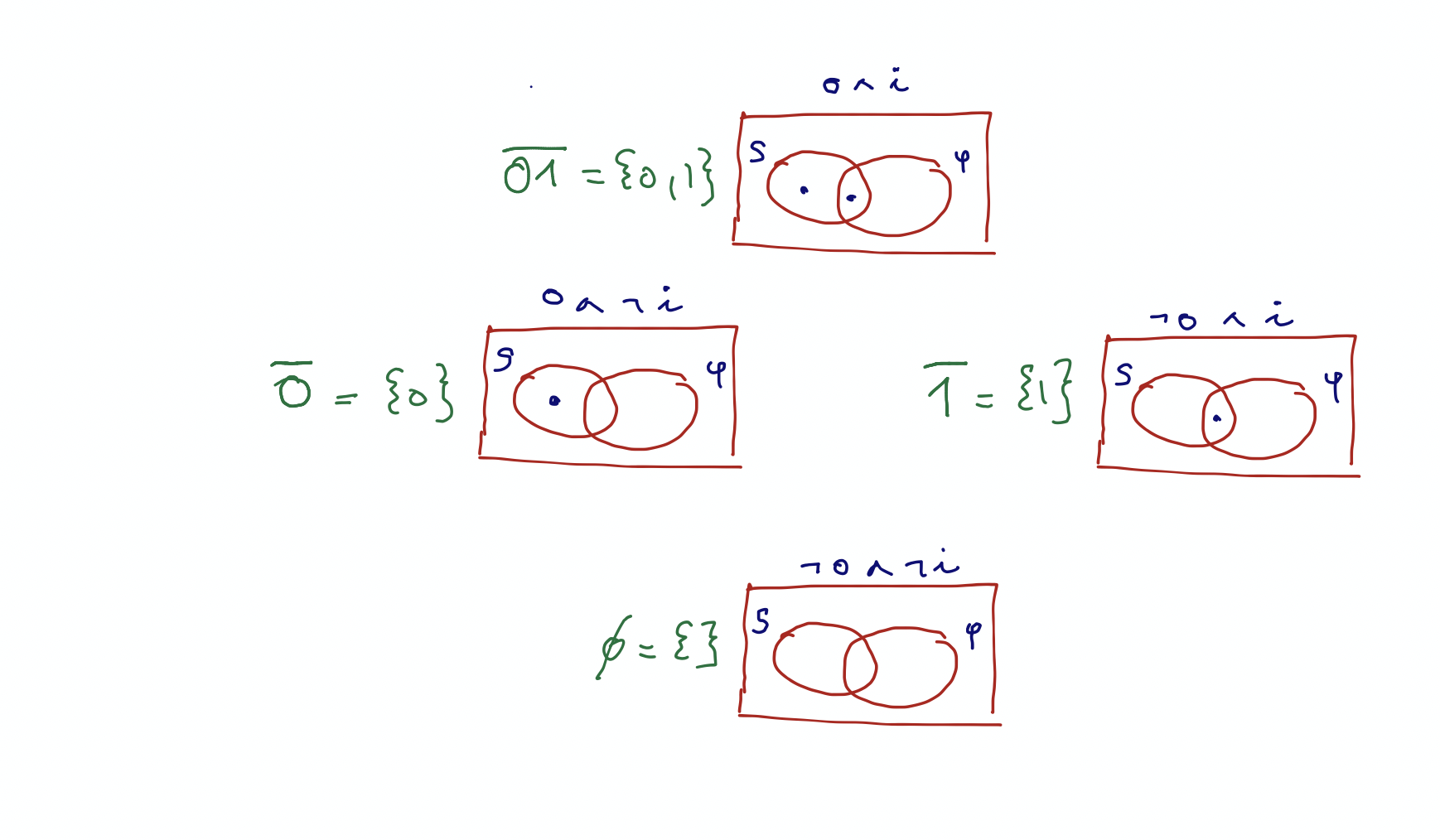
where P2\mathcal P 2 can be pictured as [1]

Which order on P2\mathcal P2 exhibits the monotone modal operators as exactly the monotone predicate liftings?

The answer is given by the so-called posetification [2]

P:PosPos\overline{\mathcal P}:\sf Pos\to Pos

of the functor P:SetSet\mathcal P:\sf Set\to Set.

Fact: P\overline{\mathcal P} is the convex powerset functor, that is, for two convex subsets a,bXa,b\subseteq X we have

ab  iff xa.yb.xy and yb.xa.xy\begin{align} a\le b\ \quad \textrm{ iff } \quad & \forall x\in a\,.\,\exists y\in b. x\le y \quad \textrm{ and }\\ &\forall y\in b\,.\,\exists x\in a. x\le y\\ \end{align}

Exercise: Recall that 2={0<1}2=\{0<1\}. The order on P2\overline{\mathcal P}2 is given by {0}<{0,1}<{1}\{0\}<\{0,1\}<\{1\}:

![](https://i.imgur.com/D8YrRFK.png =300x)

It follows that there are 2×42\times 4 monotone predicate liftings P22\overline{\mathcal P}2\to 2. The 4 upsets of the chain are

{0,01,1},{01,1},{1},{}\{\overline 0,\overline{01},\overline 1\}, \{\overline{01},\overline 1\}, \{\overline 1\}, \{\}

We can now list all monotone predicate liftings as follows.

subset of P2\mathcal P2Boolean combination of generatorsmodal formula
{}\{\}\bot\bot
{1}\{\overline 1\}¬oi\sf \neg o\wedge iϕϕ\Box\phi\wedge\Diamond\phi
{01,1}\{\overline{01},\overline 1\}i\sf iϕ\Diamond\phi
{0,01,1}\{\overline 0,\overline{01},\overline 1\}oi\sf o\vee i\Diamond\top
{}\{\varnothing\}¬o¬i\sf \neg o\wedge\neg i\Box\bot
{,1}\{\varnothing,\overline 1\}¬o\sf \neg oϕ\Box\phi
{,01,1}\{\varnothing,\overline{01},\overline 1\}¬oi\sf \neg o\vee iϕϕ\Box\phi\vee\Diamond\phi
{,0,01,1}\{\varnothing,\overline 0,\overline{01},\overline 1\}\top\top

Summary

We have seen that in the example of the powerset functor that the monotone modal operators correspond precisely to the monotone functions P22\overline{\mathcal P}2\to 2 where P\overline{\mathcal P} is the convex powerset functor.

More generally, for any set-functor TT, the nn-ary monotone modal operators (=predicate liftings) are in bijection to the monotone functions

T(2n)2\overline T(2^n)\to 2

where T\overline T is the posetification of TT.

Poset Functors

The Upset Functor

Let U\mathcal U be the upset functor. Consider

UXUϕU22\mathcal UX\stackrel{\mathcal U\phi}\longrightarrow\mathcal U2\longrightarrow 2

U2\mathcal U2 is the poset (again 01={0,1}\overline{01}=\{0,1\}, etc)

01<1<\overline{01}<\overline{1}<\varnothing

which allows us to identify monotone functions U22\mathcal U2\longrightarrow 2 with upsets:

upset of U2\mathcal U2modal formula
{01,1,}\{\overline{01},\overline 1,\varnothing\}\top
{1,}\{\overline 1,\varnothing\}ϕ\Box\phi
{}\{\varnothing\}\Box\bot
{}\{\}\bot

The difference between upsets of P2\overline{\mathcal P}2 and upsets of U2\mathcal U 2 is that in the latter case the “observation”

{01,1}=(oi)(¬oi)=i which corresponds to ϕ\{\overline{01},\overline{1}\}=\sf (o\wedge i)\vee (\neg o\wedge i) = i \quad \textrm{ which corresponds to } \quad \Diamond\phi

is not an upset of U2\mathcal U 2.

The Downset Functor

Let D\mathcal D be the downset functor. Consider

DXDϕD22\mathcal DX\stackrel{\mathcal D\phi}\longrightarrow\mathcal D2\longrightarrow 2

D2\mathcal D2 is the poset

<0<01\varnothing<\overline{0}<\overline{01}

which allows us to identify monotone functions D22\mathcal D2\longrightarrow 2 with upsets:

upset of D2\mathcal D2modal formula
{,0,01}\{\varnothing,\overline 0,\overline{01}\}\top
{0,01}\{\overline 0,\overline{01}\}\Diamond\top
{01}\{\overline{01}\}ϕ\Diamond\phi
{}\{\}\bot

The difference between upsets of P2\overline{\mathcal P}2 and upsets of D2\mathcal D 2 is that in the latter case

{,1}=(¬o¬i)(¬oi)=¬o which corresponds to ϕ\{\varnothing,\overline{1}\}=\sf (\neg o\wedge \neg i)\vee (\neg o\wedge i) = \neg o \quad \textrm{ which corresponds to } \quad \Box\phi

is not available since 1\overline 1 is not an element of D2\mathcal D2.

Breakdown of Duality

It is interesting to think about why the arguments for U2\mathcal U2 and D2\mathcal D2 are not entirely dual.

On the “object level” there is duality: Swapping 0 and 1 and turning the order around is an isomorphism.

This means that it must be the “meta level” which is breaking the duality.

Importantly, for both U\mathcal U and D\mathcal D, the meaning of the predicate liftings depends on the existential quantifier implicit in taking the direct image of ϕ\phi. For example, the statement

ϕ[S]=1 only if ϕ[S]01\phi[S]=\overline 1 \quad \textrm{ only if } \quad \phi[S]\subseteq \overline{01}

is on the meta level and does not dualise. [3]

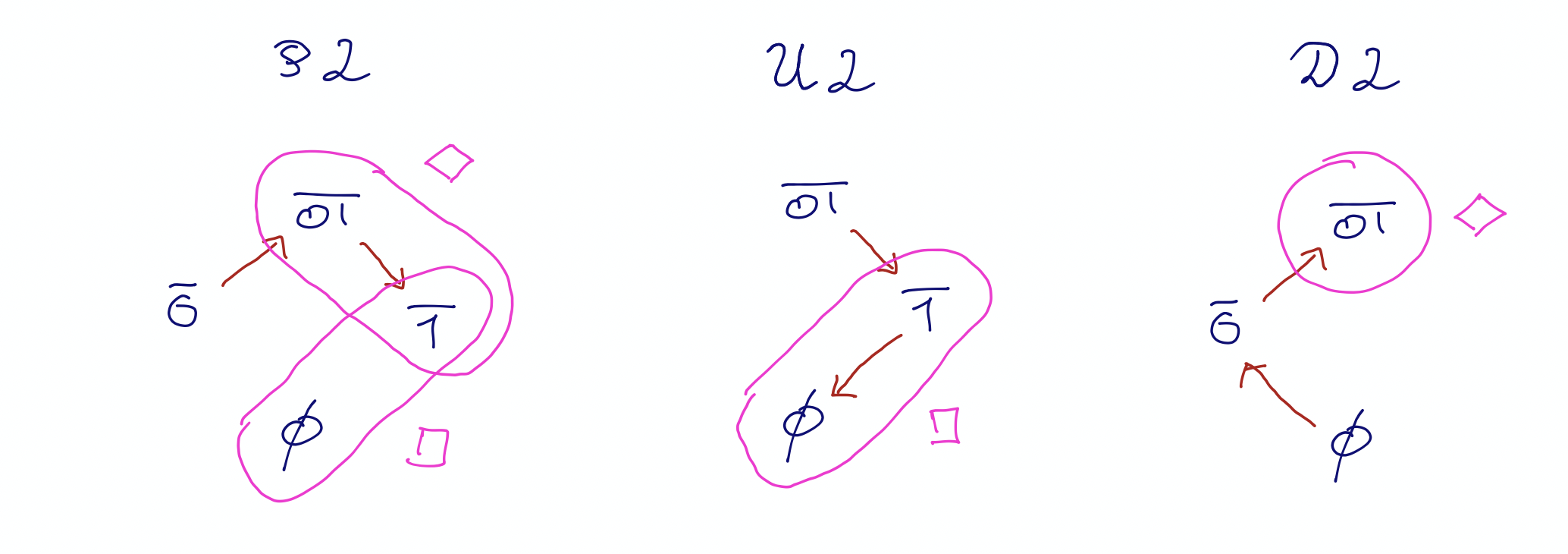
We summarise the situation with the following picture, depicting P2\mathcal P2, U2\mathcal U2, D2\mathcal D2 and the subsets that correspond to \Box and \Diamond:

Distribution Functor

Proposition: The posetification of the distribution functor is given by pqp\sqsubseteq q if p[S]q[S]p[S]\le q[S] for all upsets SS.

This order on distributions goes back to (Jones and Plotkin, 1989) for so-called IPOs and was extended to all posets in Worrell 2000. The observation that it is the posetification will appear in (Kurz and Motamed, 2022).

References

The definition of the posetification (extension from Set\sf Set to Pos\sf Pos) of an arbitrary set-functor as well as the result on monotone predicate liftings is in

Theorem 7.1 contains the result that the predicate liftings of the posetification of TT are the monotone predicate liftings of TT.

p1,p2:RXp_1,p_2:R\to X

Moreover, one can reconstruct the poset (X,R)(X,R) as a certain order-enriched colimit of the diagram p1,p2:RXp_1,p_2:R\to X. Then the posetification TX\overline TX is defined as the said colimit of Tp1,Tp2:TRTXTp_1,Tp_2:TR\to TX.

The posetification enjoys the universal property of an order-enriched left Kan extension.

Footnotes
  1. Recall that for a predicate lifting \triangle and a formula φ:X2\varphi:X\to 2, the meaning of ϕ\triangle\phi is given by how the composition PXPϕP22\mathcal PX\stackrel{\mathcal P\phi}\longrightarrow{\mathcal P2}\stackrel \triangle\longrightarrow 2 acts on a subset ‘of successors’ SPXS\in\mathcal PX.

  2. The posetification of a functor TT is defined as follows. Any poset (X,R)(X,R) can be represented by its “graph”

  3. ϕ[S]=1\phi[S]=\overline 1 only if ϕ[S]01\phi[S]\subseteq \overline{01}” is needed to establish that {01}D2\{\overline{01}\}\subseteq\mathcal D2 corresponds to ϕ\Diamond\phi.